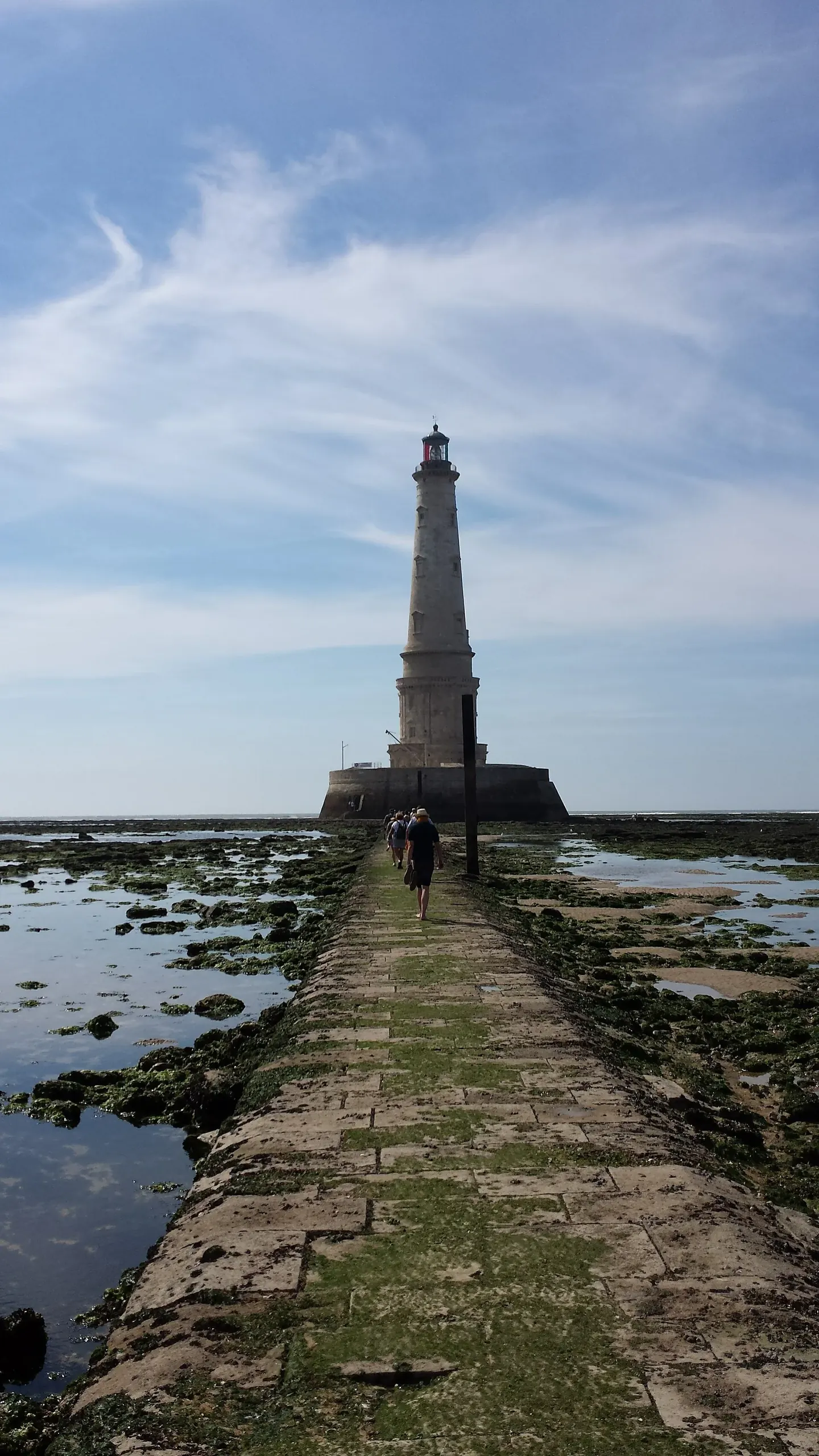
France has many celebrated lighthouses, but only one has been called the Versailles of the sea. Cordouan stands on a rocky plateau at the confines of the Atlantic Ocean and the Gironde estuary, the drowned river valley through which Bordeaux ships its wine to the world. The tower has marked that approach since the sixteenth century, and UNESCO inscribed it on the World Heritage List in 2021. It was not the first lighthouse listed: the Tower of Hercules in Spain was inscribed in 2009. What makes the building extraordinary is not simply its age or its endurance as an active aid, but the fact that it was conceived, from the first drawing, as a monument: an architectural and political statement raised in open sea.
A king's monument in open sea
The story begins in 1584, when the engineer Louis de Foix started work on the tower at the command of King Henri III. This was not a harbormaster's project but a royal one, and the ambition shows in the program of the building itself. Henri IV, who succeeded to the throne and sought to consolidate his legitimacy, developed the plan further and gave Cordouan its most improbable features: apartments for the king and a chapel, set inside a working lighthouse miles from shore. UNESCO's assessment describes the result as a monument-phare dedicated to royal power — a structure meant to be read by every maritime power in Europe as well as by local seafarers.
Teulère's raise, 1788–1789
Two centuries later the tower received its second defining act. Between 1788 and 1789 the engineer Joseph Teulère heightened the structure, and in doing so he faced a problem that every architectural addition faces: how to build onto a masterpiece without burying it. His answer was to work in the neoclassical language of the late eighteenth century and to treat the junction as an exercise in French stereotomy — the precise geometry of cut stone. UNESCO's citation for criterion (i) credits the masterly application of stereometry and stereotomy with achieving a superb integration of the addition into the existing fabric, while preserving the original symbolic program of chapel and royal apartments intact.
What the inscription actually says
The 2021 inscription rests on two criteria. Criterion (i) recognizes Cordouan as a masterpiece of maritime signaling from the seventeenth century to the present — a tribute to the glory of the kings of France, completed by Teulère's eighteenth-century raise, erected in a hostile natural environment that reinforces its status as a supreme example of human artistic, technical and technological ingenuity. Criterion (iv) recognizes it as an exemplary illustration of the great phases of lighthouse history: built with the ambition of perpetuating the tradition of the famous lighthouses of antiquity, at a time when lights served as territorial markers and safety devices, and later modified as science and technology advanced.
The citation is unusually honest about what keeps such a building alive. UNESCO's integrity and authenticity assessments note that the tower is structurally authentic and still used for its original function, but that its authenticity only makes sense in the context of an extreme maritime and meteorological environment imposing constant renovation. In other words, the building survives because maintenance is treated as part of its design, not as an interruption of it.
Who keeps it, and how
Cordouan has been classified as a monument historique since 1862, is owned by the French state, and sits within a protection system funded and directly implemented by the Ministry of Culture under the Code du patrimoine. The functional elements of the lighthouse — the active signal itself — fall to the interregional directorate of the sea for the South Atlantic, while the surrounding waters belong to the marine natural park of the Gironde estuary and the Pertuis sea. Day-to-day, the public syndicat SMIDDEST organizes paid visits to the tower and its surrounding rock plateau, and is responsible for watch-keeping against vandalism and damage to the site's flora and fauna. A local World Heritage commission coordinates the management plan.
Read the two building campaigns together
A visitor can compare the royal rooms and chapel with the later raised tower without treating them as competing explanations. One set of spaces helps explain the monument's political and architectural ambitions; the addition helps explain how later engineers carried the signaling function forward. UNESCO's assessment makes the relationship part of the significance.
A room name does not establish that a king actually stayed there. A room's name and architectural purpose are evidence of a program; a royal stay would require a separate event record. A preserved royal apartment explains intended symbolism without proving a particular monarch occupied it.
World Heritage is a statement of value, not a repair receipt
The inscription identifies qualities to protect and outlines management responsibilities. It does not establish that every later repair has been completed, that all visits occur on a fixed timetable or that ticket income covers the whole conservation budget. Those are separate operational and financial questions.
For a comparison with the Tower of Hercules, keep the inscription year and the stated reasons together. Hercules was inscribed in 2009 and Cordouan in 2021. Their different construction histories and later interventions explain why both can be important without assigning either a false first-place claim. A useful comparison asks what evidence each site preserves, rather than treating World Heritage recognition as a ranking of lighthouse age.