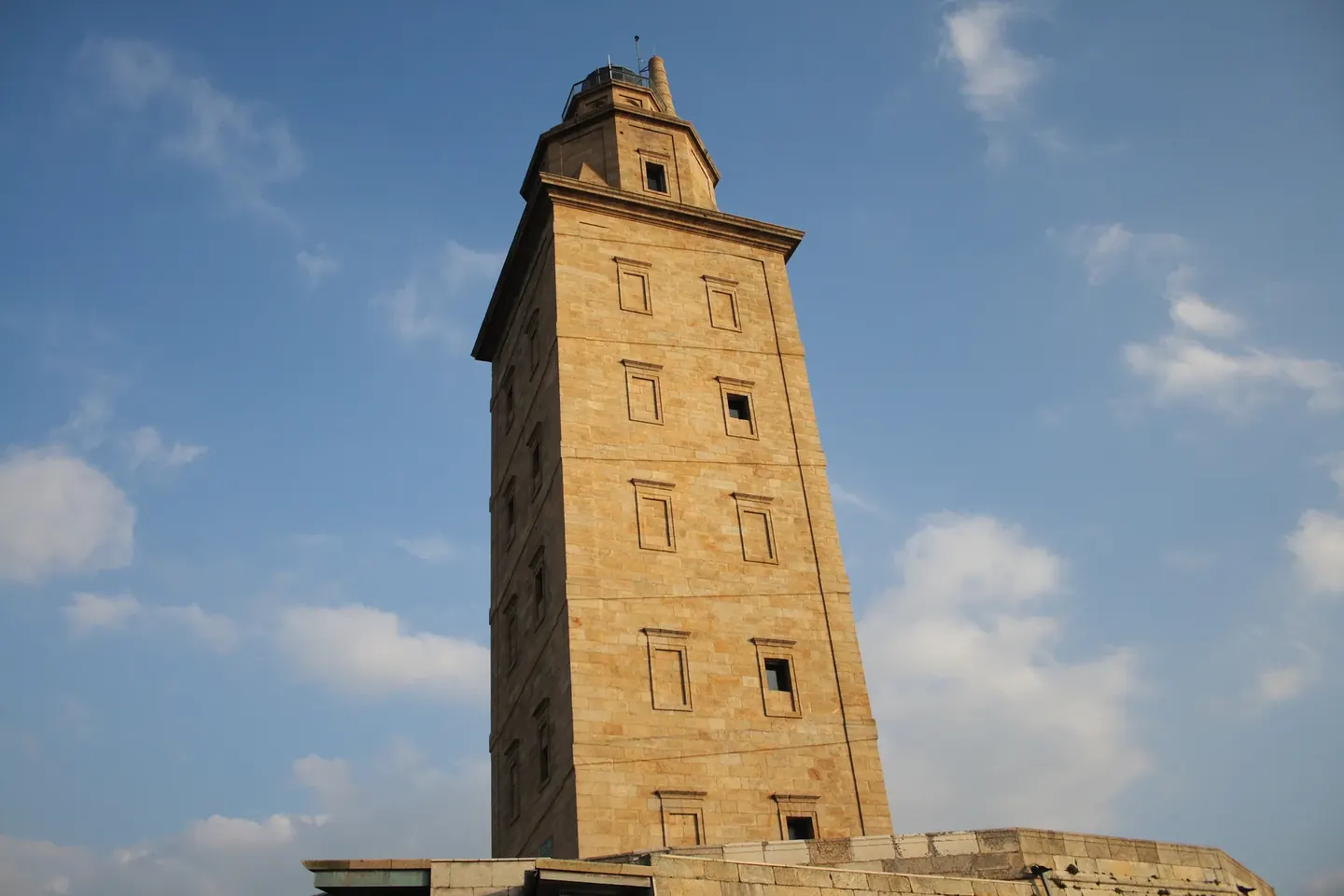
The Tower of Hercules is often introduced with a superlative: the only fully preserved Roman lighthouse still used for maritime signaling. UNESCO uses that description, while also making clear that the monument is not a Roman building left untouched. The tower rises 55 metres above a rock that is itself 57 metres high. Within the tower, UNESCO identifies 34 metres of Roman masonry and 21 metres associated with the restoration directed by Eustaquio Giannini in the eighteenth century. The surviving landmark is therefore a working structure with a Roman core and a long record of repair.
Built for a port at the Atlantic edge
UNESCO places the lighthouse at the entrance to the harbor of A Coruña in north-west Spain and dates its Roman construction to the late first century CE. The location mattered because this was a landmark at the Atlantic edge of western Europe, not a decorative tower set inland. A light could help a vessel recognize the approach to a port, while the tower itself remained visible in daylight as a coastal marker. These roles are related but distinct: a lighthouse is an operating aid, and a prominent tower also becomes part of how a landscape is described.
A Roman core inside a later exterior
That separation is not an argument that the monument is less authentic. UNESCO says the authenticity of the central Roman core is certain, while the building as a whole should be understood as a technological property requiring numerous renovations and functional adaptations. In other words, the authentic object is not just a frozen Roman shell; it is also a maintained lighthouse whose later structure made continued use possible. The restoration belongs in the history of the monument because it altered and protected the building at the same time.
What archaeology added in the 1990s
UNESCO records that excavations in the 1990s revealed the Roman foundations of the lighthouse. It also identifies a small rectangular Roman building immediately adjacent to the tower's base. These findings turn the lighthouse from a freestanding silhouette into part of a larger archaeological site. The tower is surrounded by evidence from other periods too, including Iron Age rock carvings at Monte dos Bicos and an Islamic cemetery. The site is not one archaeological moment; it is a coastal palimpsest where several histories occupy the same ground.
Legend is part of the site's history
UNESCO notes that legends surrounding the tower circulated from the Middle Ages into the nineteenth century. They are important evidence of how communities imagined the monument, but they are not a construction record. Stories associated with Hercules, giants or the founding of the city help explain the tower's cultural name and symbolic weight. They should be presented as traditions with their own histories, not as eyewitness accounts of Roman engineering. The distinction lets a reader enjoy the narrative without mistaking it for a dated archaeological fact.
Restoration as a condition of survival
UNESCO describes the eighteenth-century restoration as exemplary because it protected the central core while restoring the tower's technical function. That phrasing is useful because it avoids a false choice between preservation and operation. Restoring an aid to navigation can require new materials or changes that help it function, while conservation practice must still account for the historical fabric. The Tower of Hercules demonstrates that a monument can retain substantial ancient fabric and remain useful after major adaptation, provided that its layers are documented rather than hidden.
Still a signal, still a landmark
There is a practical lesson in the phrase “still used.” A working heritage structure is not preserved by age alone; it needs management, monitoring and attention to the conditions that let it keep functioning. UNESCO notes that conservation is monitored and that the management plan coordinates protection measures. The tower's future therefore depends on decisions made in the present, just as its current form records decisions made in earlier centuries.
Three labels for one view
When interpreting a photograph, distinguish the Roman core, the later restoration and the modern image itself. The photograph shows the building at the time of exposure. It cannot date every visible block, reveal the concealed core or establish the operating history of a lamp outside the frame.
A section or archaeological drawing supplies another kind of evidence. Its legend should identify which elements were measured and which were reconstructed. Combining the drawing with the photograph can make successive building phases easier to understand, provided the two are not presented as equivalent eyewitness records.
Apply the same approach to the name Hercules. A legend can explain cultural association while an inscription or archaeological context addresses a construction question. Keeping both in the interpretation preserves the site's later meanings without requiring the legend to do the work of a dated building record. The result is a layered monument whose continuing use depends on change, rather than an assertion that every part survived untouched.