Automation, in lighthouse practice, was never a single decision. It was a stack of small substitutions — an electric lamp in place of an oil burner, a motor in place of a keeper's arm on the clockwork, a remote circuit in place of a man on the stairs — and each substitution quietly deleted one entry from the duties listed in a keeper's daily routine. What made the process long was that the last entry, presence itself, was the hardest to price. The dates describe different changes: Boston Light was automated in 1998, but its last official keeper retired in 2023; North Foreland lost its resident keepers in 1998; and Canada still retained staffed stations after the withdrawal of keepers from two British Columbia sites in 2024. Automation and destaffing should not be treated as the same event.
What automation actually replaced
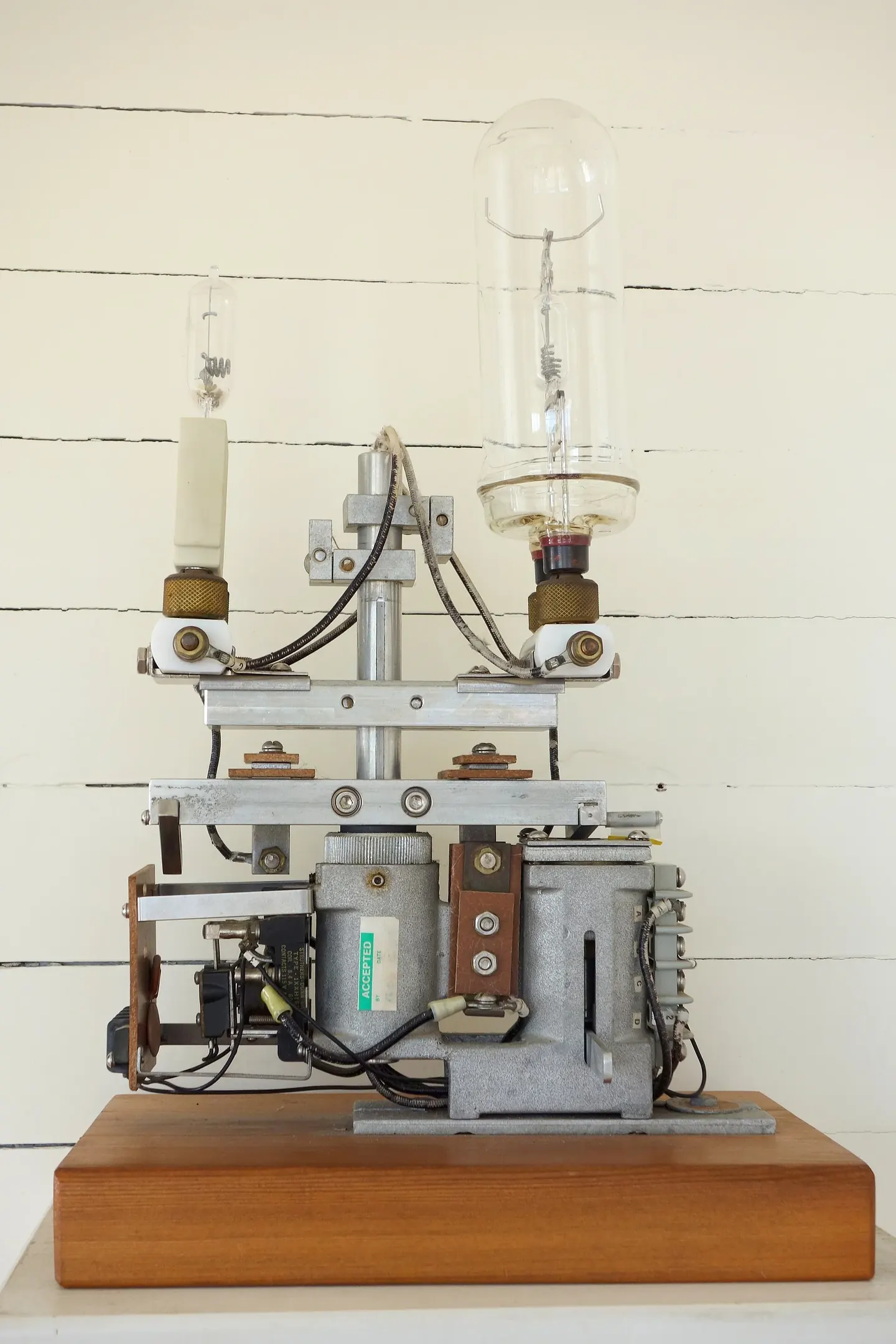
The groundwork was electrification, and the sequence is easy to read at a single station. At Boston Light, the Coast Guard electrified the light in 1948, at first using generators and batteries; in 1957 those were replaced by an underwater power cable from Windmill Point in Hull, with generator backup. The same electrification put a motor on the rotating machinery of the Fresnel lens, ending the keeper's obligation to wind the clockwork by hand every four hours — though he still climbed the stairs at sunrise and sunset to switch the light on and off. The fuel that the electric lamp displaced, from whale oil through kerosene, is traced in our history of lighthouse illuminants.
Britain: Eddystone to North Foreland
The end came on 26 November 1998, when keepers were withdrawn from North Foreland Lighthouse in Kent, the last manned lighthouse in the Trinity House service. The occasion was formally marked at a ceremony presided over by the Duke of Edinburgh in his capacity as Master of Trinity House, at which the service's final six keepers were given a formal farewell after four centuries of the profession. North Foreland is now monitored and controlled from Trinity House's Planning Centre in Harwich, Essex — the control room, in effect, became the watch room. The station's cottages, like many across Britain, later entered second lives as holiday lets, one of the quieter afterlives catalogued in our piece on what happens to decommissioned lighthouses.
Canada: destaffing, moratorium, and the lights that kept their keepers
The withdrawal of keepers from two stations in 2024 was a site-specific safety decision, not the end of Canadian lighthouse staffing. On 31 July 2024 the Canadian Coast Guard announced that it was ending staffing at Carmanah Point and Pachena Point on Vancouver Island, after a geotechnical assessment found the ground beneath many of the station buildings unstable and some facilities unsafe to use; the navigational aids themselves continue on solar power and automated technology, and the two stations' keepers were offered postings elsewhere. With those withdrawals, 25 staffed lighthouses remained along British Columbia's coast — keepers whose ongoing duties include the weather reporting that still feeds forecasting on that coast, a continuation of the observational record described in our article on keepers as weather watchers.
Boston: the machinery and the keeper had different end dates
The National Park Service records Boston Light's automation in 1998 and Sally Snowman's appointment in 2003, followed by her retirement in 2023. This is enough to show why an automation date cannot also be used as the end of keeper presence. It does not imply that the keeper continued every former task unchanged.
The Canadian staffing figures above describe the July 2024 announcement, rather than a fresh nationwide count in October 2026. A dated announcement can establish what an authority said would continue at that point. Present staffing, access and responsibilities require a current record if those details are needed for a decision.
Make a service timeline with separate rows
For a hypothetical station, put four events on different rows: electrification, automatic control, withdrawal of resident staff and transfer of buildings. A station could become electric while keepers still switch the lamp; it could become automatic while an attendant remains; and the former dwelling could change use years later. The order must come from the site's record, not from this illustrative sequence.
This timeline makes an apparent contradiction manageable. A heritage source may call a station automated while a later photograph shows a keeper there. Before declaring either wrong, ask which duty or appointment the source describes. A person maintaining grounds or interpreting history is not proof that the lamp still requires a resident watch.
Who acts when the automatic system reports a fault?
A modern service still needs a responsible organization, a way to detect discrepancies and a response arrangement. Telemetry can change the time at which a problem becomes visible to a shore team, while access and spare equipment affect what happens next. It should not be described as a perfect substitute for every observation formerly made by a resident.
The physical buildings also need their own records. A keeper's house does not automatically become surplus on the automation date, and an active navigation light can remain within a heritage property managed for another purpose. Treat the building, equipment and staffing decisions separately. That approach explains the different national examples without inventing a single final day on which lighthouse work ended.