A screw-pile lighthouse puts the support system into the foreground: an elevated building or framework stands on piles with helical elements installed in the ground. The familiar cottage above the water is only one version of the form. Understanding the support, the building and the site separately makes its history more useful than calling it a cheap solution that only ice could defeat.
The installation principle
A helical pile is turned into the ground rather than simply resting a broad masonry base on the surface. Several supports can carry a platform and the structure above it. This description explains the principle; it does not supply embedment, capacity or suitability for a particular seabed.
The invention is associated with Alexander Mitchell and nineteenth-century applications to maritime structures. Patent, first construction and first lighting are separate milestones. A project that began first need not have entered service first, so rankings require a consistent event and reliable project dates.
Do not confuse a visible frame with its concealed foundation
An iron skeleton tower may look similar to another tower while using different connections below the water. The form above the surface does not establish that every support ends in a screw. A foundation drawing or construction record is needed to identify that part of the system.
Likewise, a cottage-shaped building on piles is not a statement about how quickly it could be built or how well it would resist every environment. A photograph establishes the visible form at a particular time. It cannot measure ground strength, concealed corrosion or the condition of submerged connections.
Thomas Point: a documented surviving example
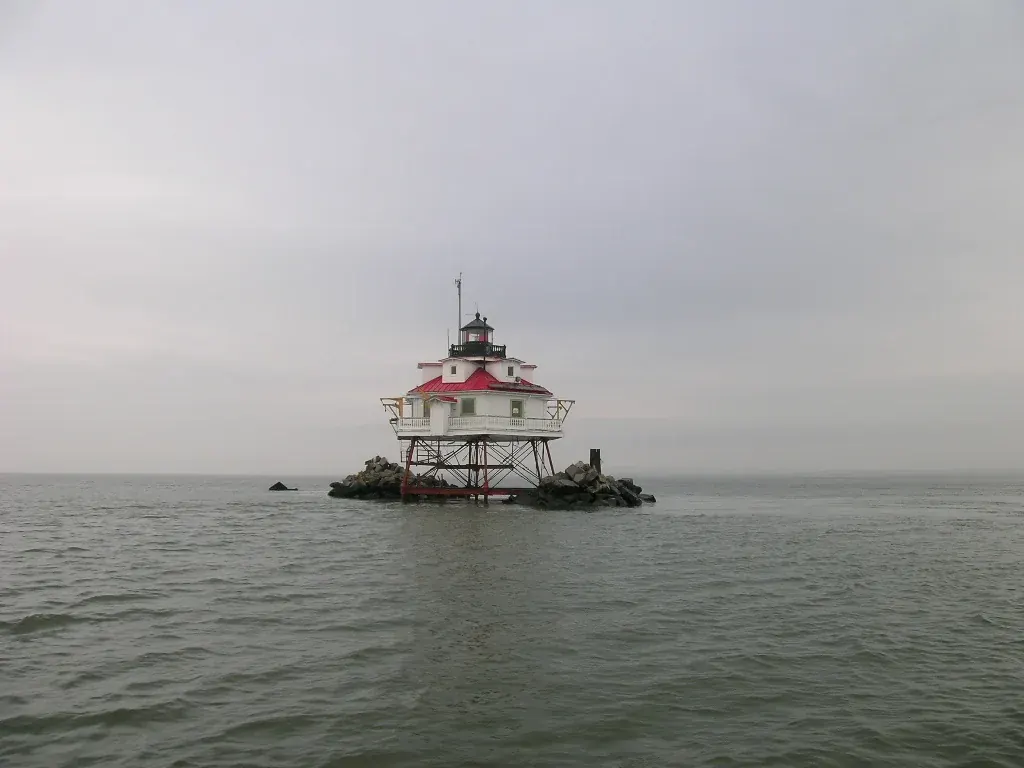
The Thomas Point Shoal Lighthouse steward dates the structure to 1875 and describes it as an active aid to navigation. Its cottage and exposed supports make the relationship between accommodation, lantern and foundation particularly clear. The structure's survival also makes later preservation decisions part of its history.
Use the actual designation and stewardship records for claims about original fabric, ownership or superlatives. “Unaltered” can conceal repairs and protective additions, while “only survivor” depends on whether the claim means a type, an original site or a particular degree of preservation. This article does not require a worldwide uniqueness claim to explain the example.
Compare a station on site with one moved ashore
Historic Ships in Baltimore presents Seven Foot Knoll as a screw-pile lighthouse in its collection. A relocated building can preserve important architectural evidence while changing its relationship to the original seabed. It should not be used as a direct demonstration of the foundation still carrying it at the old station.
For a hypothetical museum comparison, label the surviving building, reconstructed supports and original-site evidence separately. A cutaway or model can explain the submerged system without claiming every displayed part came from the working station. That distinction protects the value of the preserved object rather than diminishing it.
Ice is one exposure, not the entire explanation
Historical accounts describe ice damage to some pile-supported lights. That does not prove screw piles never failed for other reasons or were automatically suitable wherever ice was absent. Material condition, ground, connections, loads and maintenance all belong in a site-specific assessment.
A comparison with a caisson should therefore begin with the documented problem. Was the change prompted by observed damage, a changed service requirement or another condition? Substituting the phrase “ice defeated the screws” for the actual record can obscure both the design and the subsequent decision.
A foundation label is the beginning of investigation
Make a small record containing the support type, installation evidence, building form and later alterations. Add the ground description only where a survey or reliable project account supplies it. If the underwater arrangement is unknown, mark that gap rather than infer it from a neighboring lighthouse.
For example, a hypothetical repair proposal might concern a platform connection while leaving the piles in place. Calling it a new foundation would overstate the work; calling it merely painting would understate it. The component boundary helps readers understand what a restoration report actually describes.
An inspection date matters as much as a construction date when describing condition. A historic designation records recognized significance; it does not certify that concealed supports remain sound today. Keep the preservation status and any current engineering assessment in different fields.
Why the type remains worth studying
Screw-pile lights connect a nineteenth-century installation method with accommodation, signal equipment and ongoing asset care. They also challenge the claim that every lighthouse needed natural rock at the surface. The navigation task could be served through more than one structural approach, depending on the site and available methods.
The foundation comparison follows those broader support principles; lightships considers a floating alternative. Here, the distinctive lesson is to connect the visible cottage or frame with evidence for the support beneath it, while keeping historic explanation separate from an engineering design or a current safety certification.