A lighthouse foundation must connect a structure to a particular site. The useful question is not simply whether the tower stands on rock, sand or mud, but how loads pass through the support and how that setting may change. Foundation type, tower material and shoreline protection are related decisions; none supplies a complete answer for the others.
Separate three parts of the problem
First identify the tower and its connections. Next identify the foundation system and the ground supporting it. Finally describe the surrounding coast or seabed. A visible crack in masonry, settlement beneath a support and erosion nearby are different observations. Establishing a cause requires evidence connecting them, rather than the assumption that the largest wave must be responsible.
The same distinction helps with old drawings. A line labeled “rock” is a description in a particular survey, not proof that every part of the foundation bears on sound material. Inspection records and later changes belong alongside the original design. A structure can remain substantially intact while its supporting environment becomes less satisfactory.
Cape Hatteras: spread the load, then confront the coast
The National Park Service describes the original foundation of the 1870 Cape Hatteras tower as crossed pine timbers below the water table with granite above. That arrangement belongs to the building's initial construction problem. The later retreating shoreline posed a different problem, eventually prompting the light station's 1999 relocation.
These events should not be compressed into “the foundation failed.” A decision to move a tower away from an eroding coast does not by itself establish collapse, inadequate original workmanship or a defect in the brick walls. The relocation case concerns the decision and execution of that move; the foundation comparison here concerns what supports the tower.
Screw piles: the support extends into the seabed
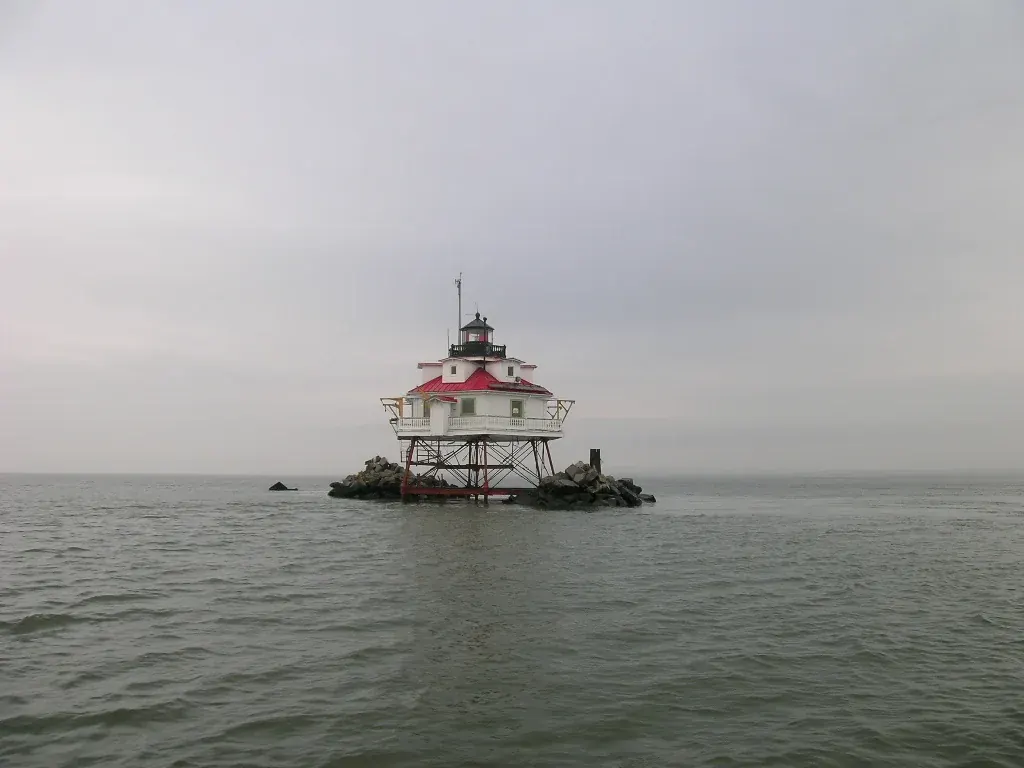
A screw pile has a helical element that is turned into the ground. Several supports can carry a platform or dwelling above water. This is different from a tower whose broad base bears on a prepared surface. The distinction is a load-transfer principle, not a rule that screws work in every soft bottom or eliminate foundation risk.
At Thomas Point Shoal, the preserved cottage and its visible iron supports make that relationship legible. Historic designation records provide a better starting point for the particular arrangement than counting supports in an oblique photograph. The number of piles, later reinforcement and the original design should not be inferred from a single view.
For a comparison, ask what information is missing: the ground investigation, embedment, condition of connections or history of ice exposure. Naming the foundation type narrows the questions; it does not provide the measurements needed to answer them. Our screw-pile article follows the type's historical applications.
A pneumatic caisson changes the construction environment
The Coast Guard identifies Fourteen Foot Bank's present tower as first lit in 1887 and records a cast-iron and concrete caisson foundation. National Register documentation describes its significance in the early American use of the pneumatic caisson process for lighthouse construction.
In that process, a pressurized working chamber allowed excavation beneath the structure while excluding water. As material was removed, the caisson could descend. It is more precise to describe this controlled excavation than to say a caisson simply replaces the seabed with manufactured ground. Nor should every caisson be called pneumatic: the term identifies a particular construction method.
The historic account is not a present-day work procedure. Air pressure, worker exposure and sinking control require specialist design and operations. A public history can explain the principle without prescribing an excavation sequence or treating a nineteenth-century crew's experience as a safe template.
Scour and shoreline retreat are different observations
Scour concerns local removal of bed material around a structure; shoreline retreat concerns a changing coastal position. Either can matter to a lighthouse, but evidence for one does not automatically measure the other. A patch of protective stone visible at low water cannot, by itself, prove the depth or condition of a concealed foundation.
A useful monitoring record repeats comparable observations: the date, water or tide conditions, survey reference, location and extent of the observed change. Photographs taken from unrelated positions may illustrate appearance but make poor measurements of movement. Distinguish a suspected change from a surveyed one.
When comparing preservation options, keep the tower's condition, the support's condition and the site's trajectory in separate columns. That arrangement makes discussions of repair, protection or relocation more specific. It also prevents a familiar story about a strong tower and a hostile sea from standing in for the actual engineering evidence.
What a visitor can and cannot conclude
At a museum display, a model of piles or a section through a caisson can explain how a system was intended to work. Label whether it represents the original design or a later arrangement. The model does not certify the present structure, and an exposed part does not disclose the condition below water. Keeping design explanation separate from condition assessment allows public interpretation to remain useful without making unsupported claims about present stability.