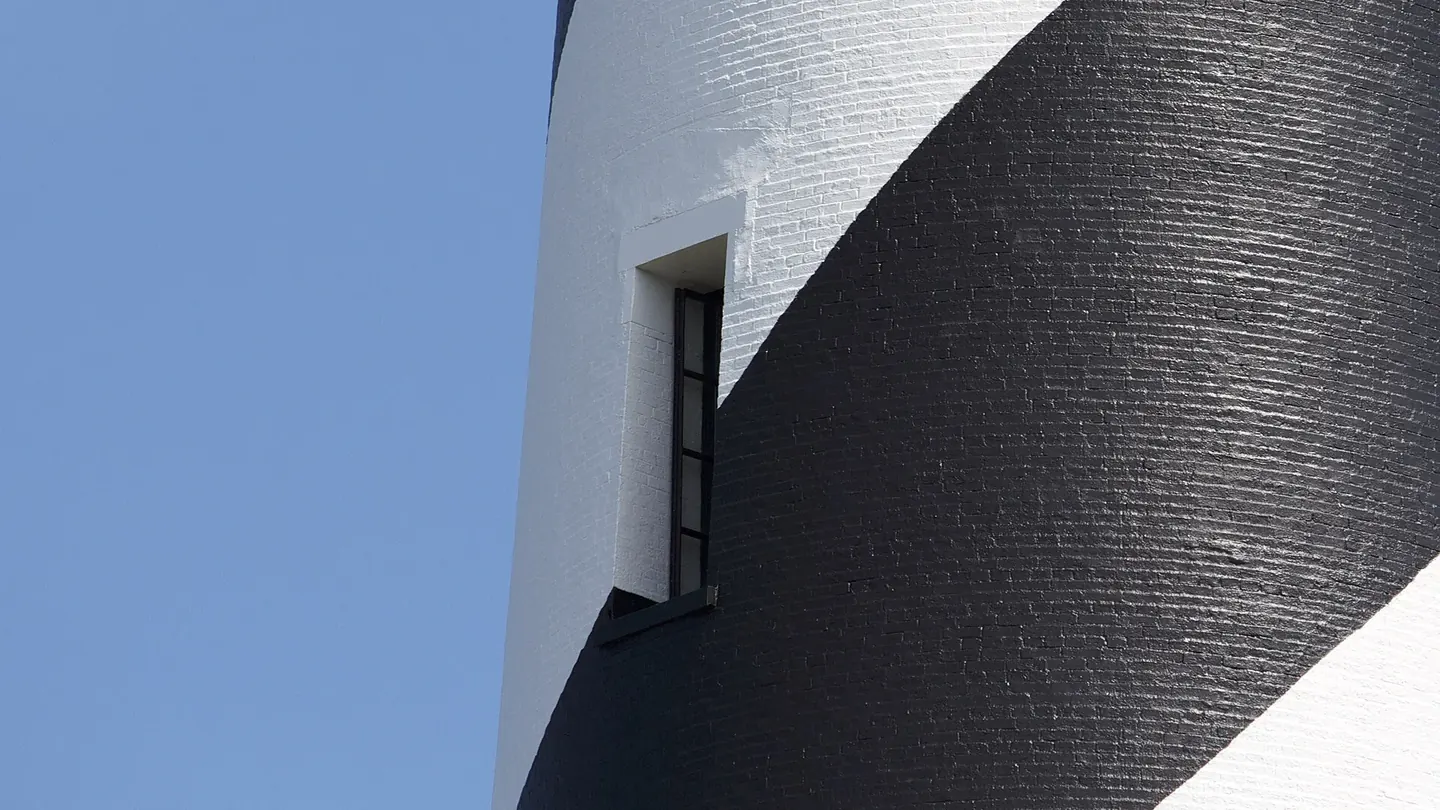
No lighthouse in America is more instantly recognizable than Cape Hatteras. The black and white spiral wrapped around its 198-foot brick shaft was painted in 1873 so that mariners could tell the tower apart from every other light on the coast by daylight — a system the Lighthouse Board applied nationwide, as we explain in our piece on daymarks and paint patterns. But the tower's most remarkable chapter is not its construction. It is the summer of 1999, when the National Park Service detached the entire structure from the ground and moved it 2,900 feet inland, one five-foot push at a time.
A tower built too close to the sea
The present lighthouse was first lit on 16 December 1870, standing 1,500 to 1,600 feet from the waterline. For a coastal light of 1870, that buffer was considered generous — more than a quarter of a mile of dune between the lamp and the sea. The Outer Banks, however, are barrier islands that have been migrating westward for thousands of years, with storms stripping sand from the ocean side and redepositing it on the sound side. The shoreline in front of the tower did not so much erode as travel.
The Park Service's timeline records the narrowing in stark numbers: 1,400 to 1,500 feet from the sea in 1893, less than 300 feet by 1919, less than 100 feet by 1933. Steel groins were installed in 1930 and again in 1933 to trap sand, and the CCC built dune lines in the 1930s, but the trend was not permanently reversible. In 1935, with waves washing against the base, the Bureau of Lighthouses gave up and moved the beacon to a steel skeleton tower inland; the light only returned to the brick tower in 1950, after the beach had rebuilt itself naturally. Cracks found in the structure closed it to visitors in 1975, and by 1980 the tower stood roughly 50 to 70 feet from the surf. Electricity reached the tower in 1934, and its original Fresnel lens, vandalized over the difficult decades, was removed in 1949 — a year before the light came back to the brick shaft.
Study, argument, and a decision
The engineering of the move
The move itself was a masterpiece of unglamorous method. In March 1999 the supporting buildings — the double keepers' quarters, the principal keeper's quarters, the oil house and the cisterns — were hauled to the new site first, so that they could be re-sited in exactly the same positions relative to the tower as before. Then, on 17 June 1999, work on the tower began.
The National Park Service's account describes the sequence. The 4,830-ton brick structure was separated from its original foundation and transferred onto a transport support system of some 400 tons of steel: beams and hydraulic jacks that carried the tower while it slid along a metal runway track. Push jacks drove the frame forward five feet at a time. Sixty sensors measured tilt and vibration continuously, and a weather station at the top of the tower tracked wind speed and temperature, because a tower this tall catches wind like a sail.
The journey took 23 days, ending on 9 July 1999, at a site 2,900 feet southwest of the old foundation. The new position restored the original geometry: the tower once again stood about 1,500 feet from the ocean, the same distance as when it was built 129 years earlier. The lighthouse reopened to the public on 13 November 1999, and the project earned a national engineering award.
Preserve relationships, not only the tower
The NPS cultural-landscape account emphasizes that the supporting buildings moved while retaining their historic spatial arrangement. That choice protected a relationship between structures, not just the recognizable silhouette. A plan comparing the two locations should show the whole station rather than place the lighthouse alone on an otherwise blank new site.
It is also important to distinguish restored distance from restored ground. The new location recreated an approximate relationship to the ocean, but it was not the original foundation or an unchanged piece of coastline. Relocation preserved some aspects of the historic landscape while altering others.
A completed move does not settle every future question
The successful 1999 operation demonstrates what was accomplished under that project's conditions. It is not a general instruction for moving any coastal tower, nor a guarantee that the new location can never need further assessment. A different building, ground condition or route would require its own investigation.
For present visitors, the NPS station page says the lighthouse will not open for climbing in 2026 because of restoration. That dated notice is separate from the November 1999 reopening after the move. A historical reopening date must not be presented as current availability, and an expected future opening should not be reported as completed until the operator confirms it.