A tower that could not be built
Some of the most dangerous places on a coast are the hardest to mark. A lightship could mark a location where a fixed beacon was difficult to provide. The National Park Service's maritime historians describe the lightship plainly: a floating lighthouse, designed for use in coastal waters where a fixed beacon cannot readily be placed. The idea was old in Europe, but the United States adopted it late. The first American lightship was installed at Willoughby Spit, Virginia, in 1820, soon moved to Craney Island near Norfolk, and was quickly followed by four more in Chesapeake Bay.
Named for the station, not the ship
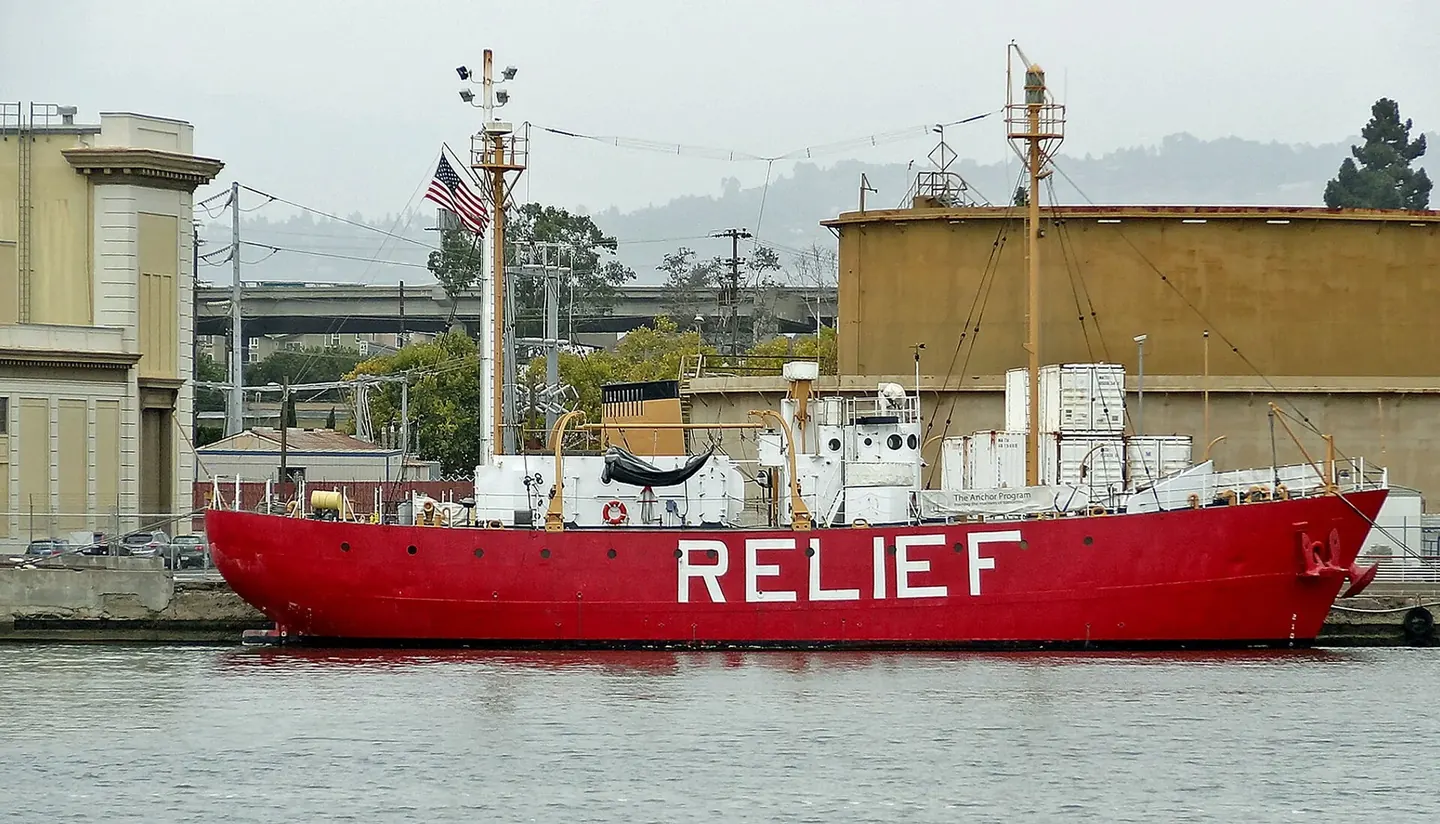
A lightship's identity was the hazard it marked, and the service made that literal: the vessel's name was painted on its hull in large white letters, and the name was the name of the station. When a new hull took over the post, it inherited the old name. Lightship No. 116 was lettered "Fenwick" for the station off Fenwick Island, Delaware, from 1930 to 1933, "Chesapeake" for its twenty-nine years off the mouth of Chesapeake Bay, and "Delaware" for its final posting at the entrance of Delaware Bay. The hull was painted bright red; the masts carried the lights, with cones, cages and other daymarks rigged above or below the lanterns; anchors held her on station.
Chesapeake: a working biography
The Second World War interrupted the routine: pressed into Navy service, she carried two 20-millimetre guns and served off the New England coast before returning to Chesapeake Bay in 1945. The sea collected its toll in peacetime as well: in 1936 a hurricane dragged her from position, sweeping away her deck furniture and costing her one of her mushroom anchors. The end came by replacement rather than failure — a platform light took her station in 1965, a large navigational buoy replaced her at Delaware Bay in 1970, and the Coast Guard decommissioned her in 1971 and transferred her to the National Park Service. Today she rests at Baltimore's Inner Harbor as a museum ship, one of the last places where the lightship way of working can be examined hull by hull. The tenders that serviced ships like her have their own story.
Why the lightship disappeared
The lightship was always an expensive answer: a crewed vessel that had to be relieved, reprovisioned and repaired, moored where storms were worst. Technology eroded its reason to exist from both directions. On one side came fixed structures — screw-pile and caisson lights in the nineteenth century, and by the 1960s platforms resembling oil drilling rigs. On the other came floating automation: large navigational buoys in the 1970s, part of the same automation wave that ended keeper service ashore, chronicled in our piece on automation and the last keepers. The last American lightship, Nantucket I, was decommissioned in 1985, closing a career that had begun at Willoughby Spit 165 years earlier.
Two identities belong in the record
Use the vessel number for the hull and the station name for the assignment. Then give each assignment its dates. A photograph labeled Chesapeake may show a particular hull in that role, but the word alone cannot establish which vessel or which year. Museum repainting can also restore a former name after the working career ended.
The National Register description of No. 116 records Fenwick, Chesapeake and Delaware lettering at different stages. Its later Chesapeake appearance commemorates a long assignment. That history is a reason to keep a hull timeline and a station timeline side by side, not to treat every change of paint as a new ship.
A lightship did not require impossible ground everywhere
Lightships served where a fixed aid could not readily be provided under the circumstances. This is different from claiming no foundation could ever be built on mud or in deeper water. Changes in construction methods, service needs and cost could change the preferred solution at a location.
For a hypothetical shoal, compare three systems: a crewed anchored vessel, a fixed support and an automated buoy. Record the marking task, maintenance access, power and method of remaining on station. A buoy is not simply a ship without crew; a fixed tower does not solve the same station-keeping problem in the same way.
A museum ship represents a period, not every period at once
Historic Ships in Baltimore's account describes No. 116's diesel-electric arrangement and changes to its signaling equipment. An object present on the ship today may reflect later service or preservation work. A visitor should ask which date the display represents before comparing it with a builder's photograph.
A design group dating to 1929–1930 is one stage in the fleet's development. Later vessels and surviving examples require their own construction dates, rather than being absorbed into a convenient final-generation label. No. 116 can explain one important design and career without standing in for every subsequent lightship.
Its current operator's page supplies visiting information; historical service dates do not guarantee public access on a particular day. For vessel logistics, continue with the tender fleet. The lightship's distinctive contribution remains a fixed signaling assignment carried by a vessel whose own identity could persist through several named posts.