Cutting the lens into rings
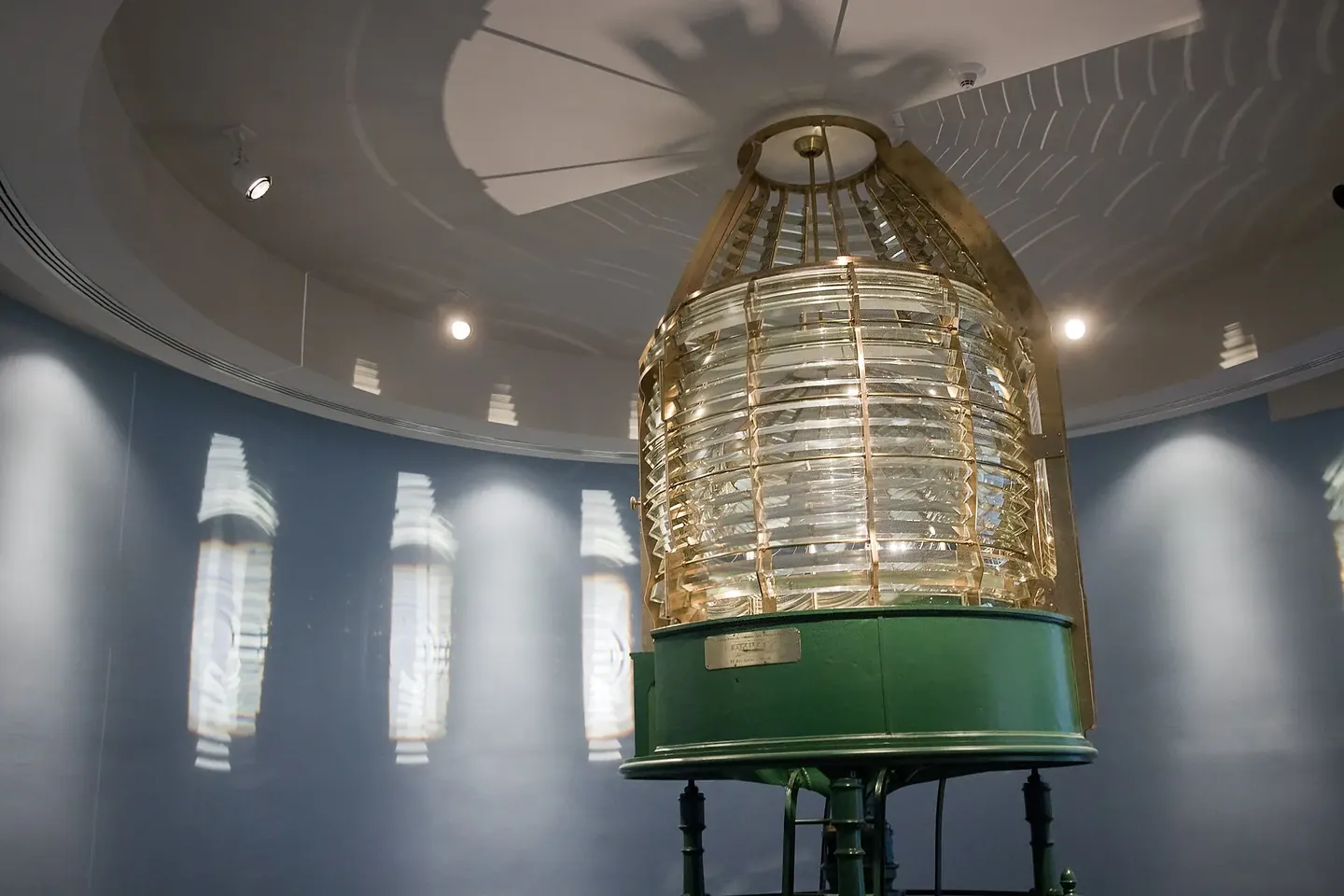
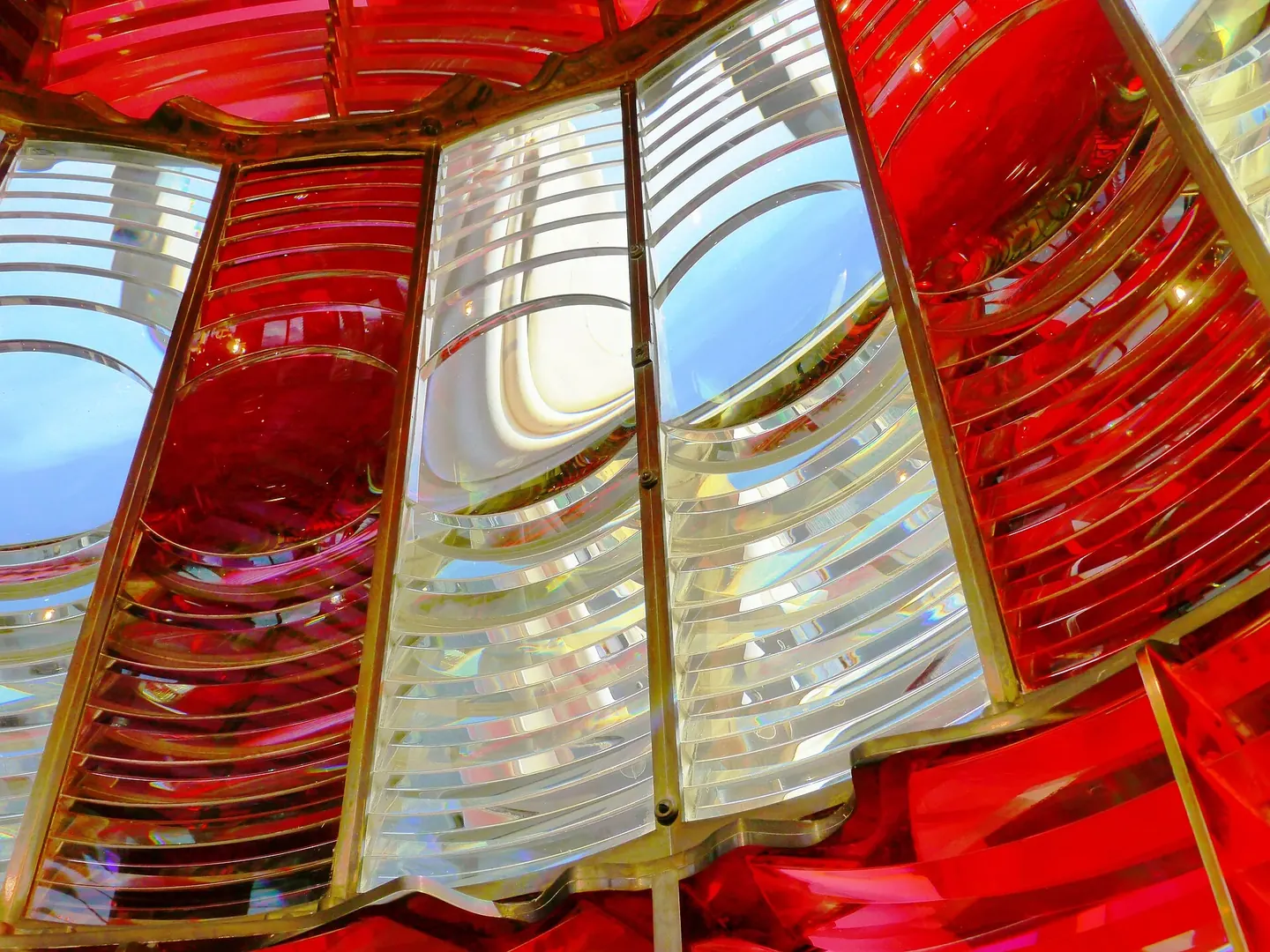
A conventional magnifying lens of the necessary power would have been absurdly thick — heavy, expensive to grind, and so deep in glass that much of the light passing through it would be absorbed before it ever left. Fresnel's insight was that only the curved surfaces of a lens do the optical work. He therefore cut the imagined thick lens into a set of concentric annular sections, collapsing each ring to a thin prism, and assembled the result around a central bull's-eye. As the National Park Service's history of the Old Point Loma light describes the apparatus, a Fresnel lens "is like a glass barrel whose outer surface is made up of prisms and bulls-eyes." The central drum refracts the light; the rings around it bend it again into a flat, concentrated sheet.
Fixed sheets and revolving spokes
The same optics produce two very different kinds of light. In a fixed, or steady, light, the bull's-eyes merge into a continuous lens belt with the prism rings parallel to it, producing what the Park Service historians call "an uninterrupted, horizontal sheet of light" around the horizon. In a revolving or flashing light, the bull's-eyes stand apart, each surrounded by its own curved concentric prisms, concentrating the lamp into several individual beams that radiate like the spokes of a wheel. As the apparatus turns, the mariner sees darkness, then a flash, then darkness again — a signature far more identifiable than a steady glow, and the reason flashing lenses dominated the great coastal lights.
The design's triumph was not instant, and the American lag is its own story. The United States purchased its first Fresnel lens in 1841 and installed it at Navesink, New Jersey, as a test — then dawdled: ten years later, only three light stations in the country had lenses. The Fifth Auditor of the Treasury, who supervised the lights, clung to his Argand lamps; as late as 1852 he recommended that the new San Diego lighthouse be lit with twelve lamps and twelve sixteen-inch reflectors. Congress forced the issue in March 1851 by authorizing the new system in its appropriations, and after the Lighthouse Board took office in 1852 the conversion proceeded fast. By 1859 the Argand-and-reflector system had been almost entirely replaced throughout the country.
Follow rays, not a claim that glass creates light
A lamp emits light in many directions. In a simplified lens drawing, follow several rays from the source to the optical surfaces and then toward the intended beam. The glass changes their directions; it does not supply additional energy. Concentrating light in a useful direction can make the signal more conspicuous there without implying that the lamp emits more total light.
Stepping the lens reduces the amount of glass needed for a comparable surface arrangement. The discontinuities and separate elements still require careful manufacture and alignment. “Only the surfaces do the work” is a useful introduction, but not a claim that glass properties, thickness or losses can be ignored in a complete optical design.
Cordouan's first installation was a mixed arrangement
The French Ministry of Culture describes the July 1823 apparatus as an octagonal drum with stepped lenses, mirrors below and additional lenses and mirrors above. A clock mechanism controlled rotation. This is evidence for a particular early installation, rather than proof that every later Fresnel apparatus had the same parts.
The source describes a steady appearance with periodic brighter pulses. That nuance matters: the first installation should not automatically be drawn as isolated flashes separated by complete darkness. The observed rhythm depends on the complete arrangement and its motion, not merely on the word Fresnel.
A useful comparison needs the same question
If comparing an optic with a reflector, specify what is held constant: the source, fuel consumption, observed direction and measurement method. A statement about intensity in one beam is not automatically a statement about efficiency across the whole apparatus. A universal utilization percentage would require defined test conditions and a clear boundary around the light being measured; one station's result should not be generalized to every assembly.
Nor does a more concentrated beam defeat the horizon. Its detectability still depends on atmosphere and geometry. Use the range article for those separate limits. The optic answers how light is redirected; it cannot establish an observer's height or clear an intervening obstruction.
Read a museum lens as an assembly
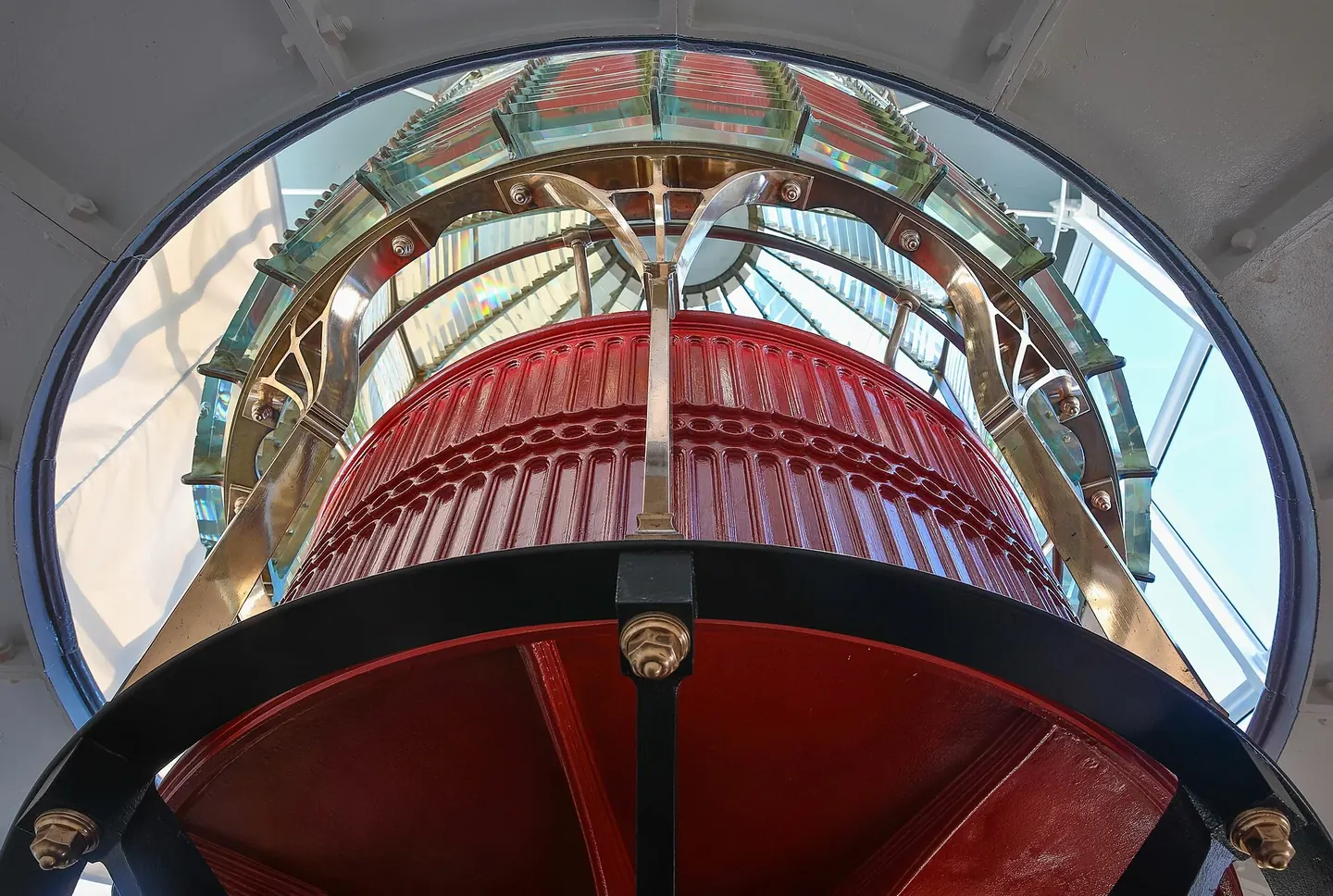
Identify the lamp position, central belt or panels, surrounding prisms and supporting framework. Then ask which parts belonged to the displayed operating arrangement and which may have changed. An empty lens display can explain optical form without demonstrating the brightness or rhythm it produced in service.
The size classification belongs in the orders guide, and the drive belongs in rotation mechanisms. Keeping those tasks apart makes the main principle easier to see: an organized set of optical surfaces redirects a source into the distribution of light needed for a signal.