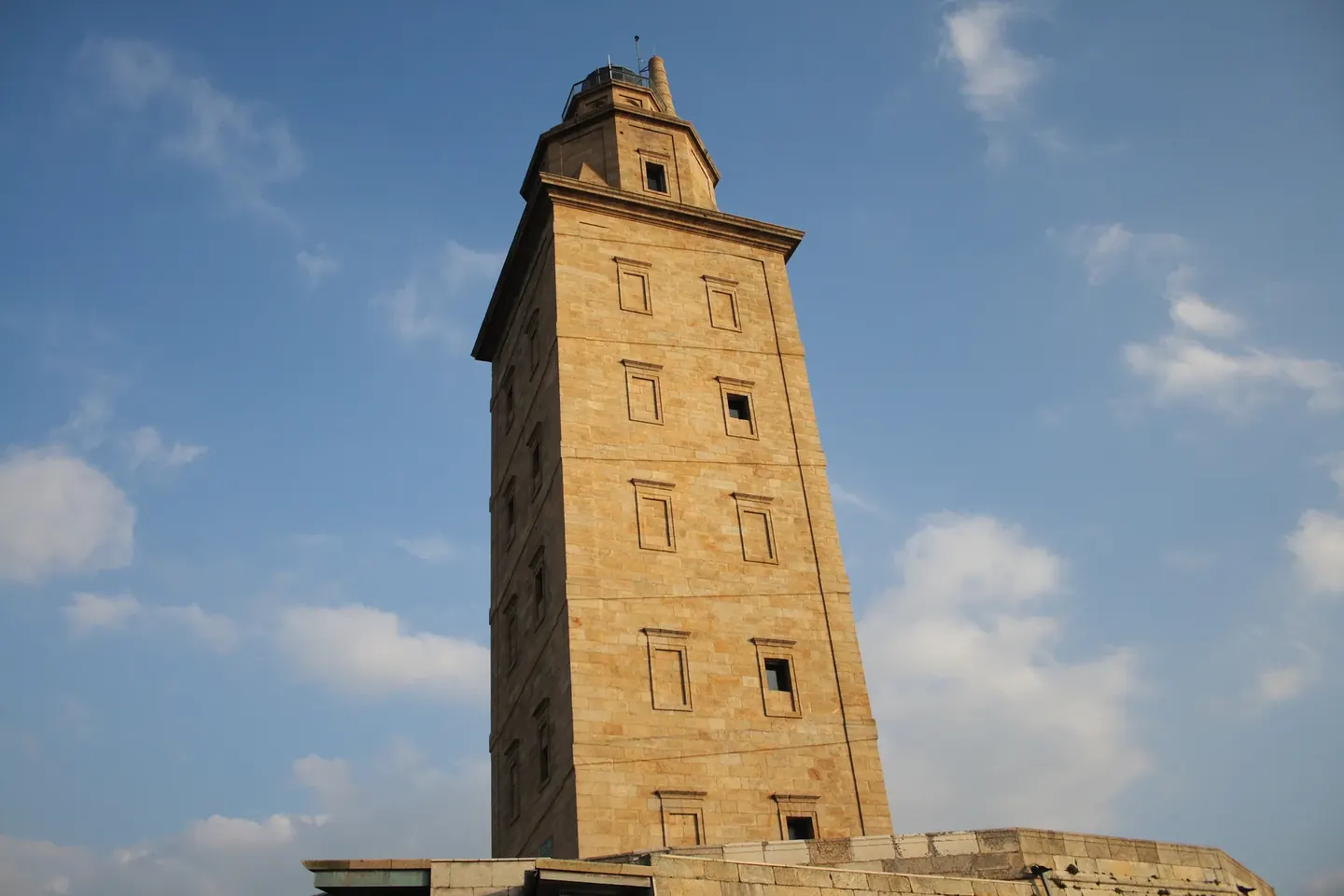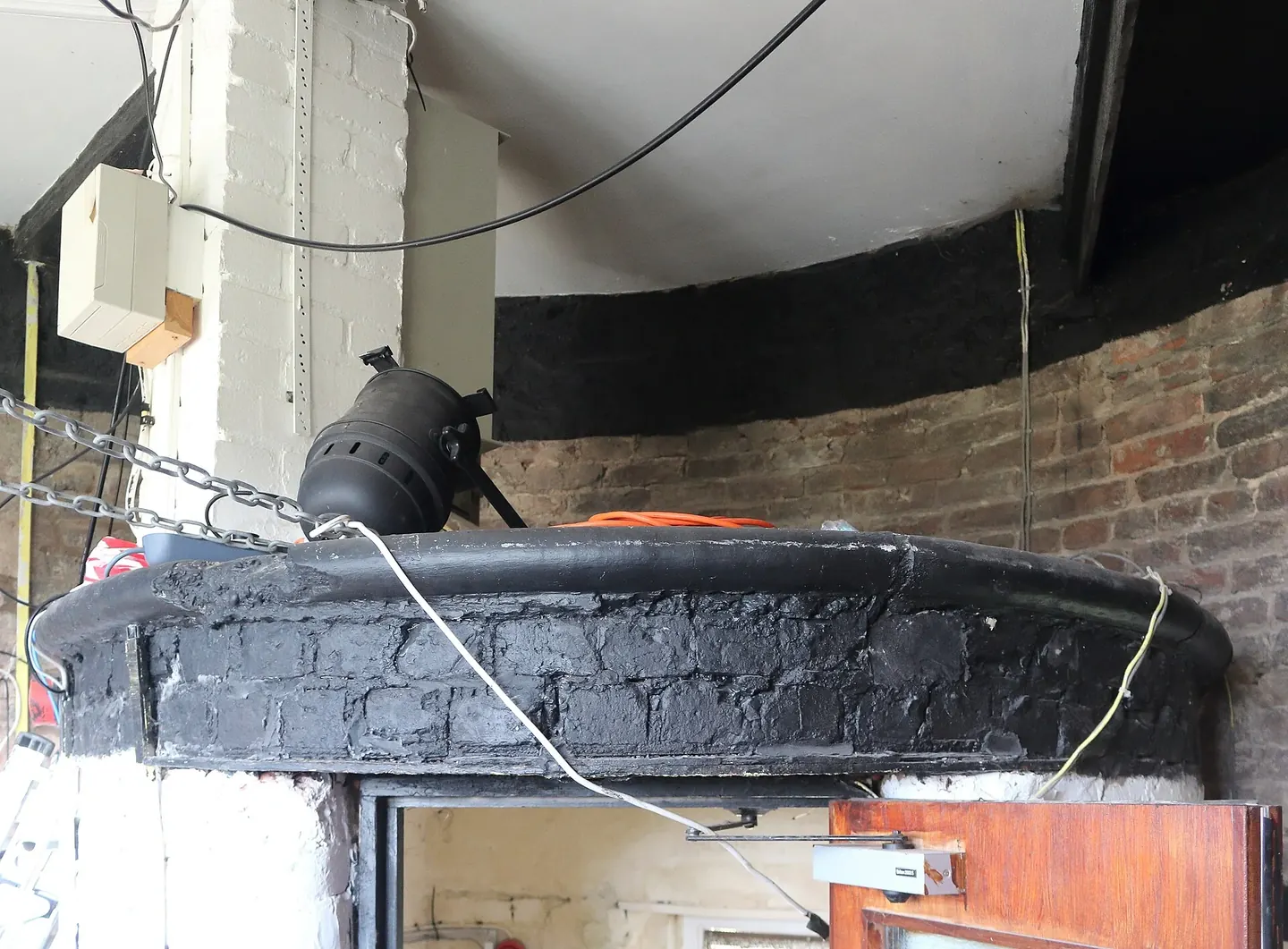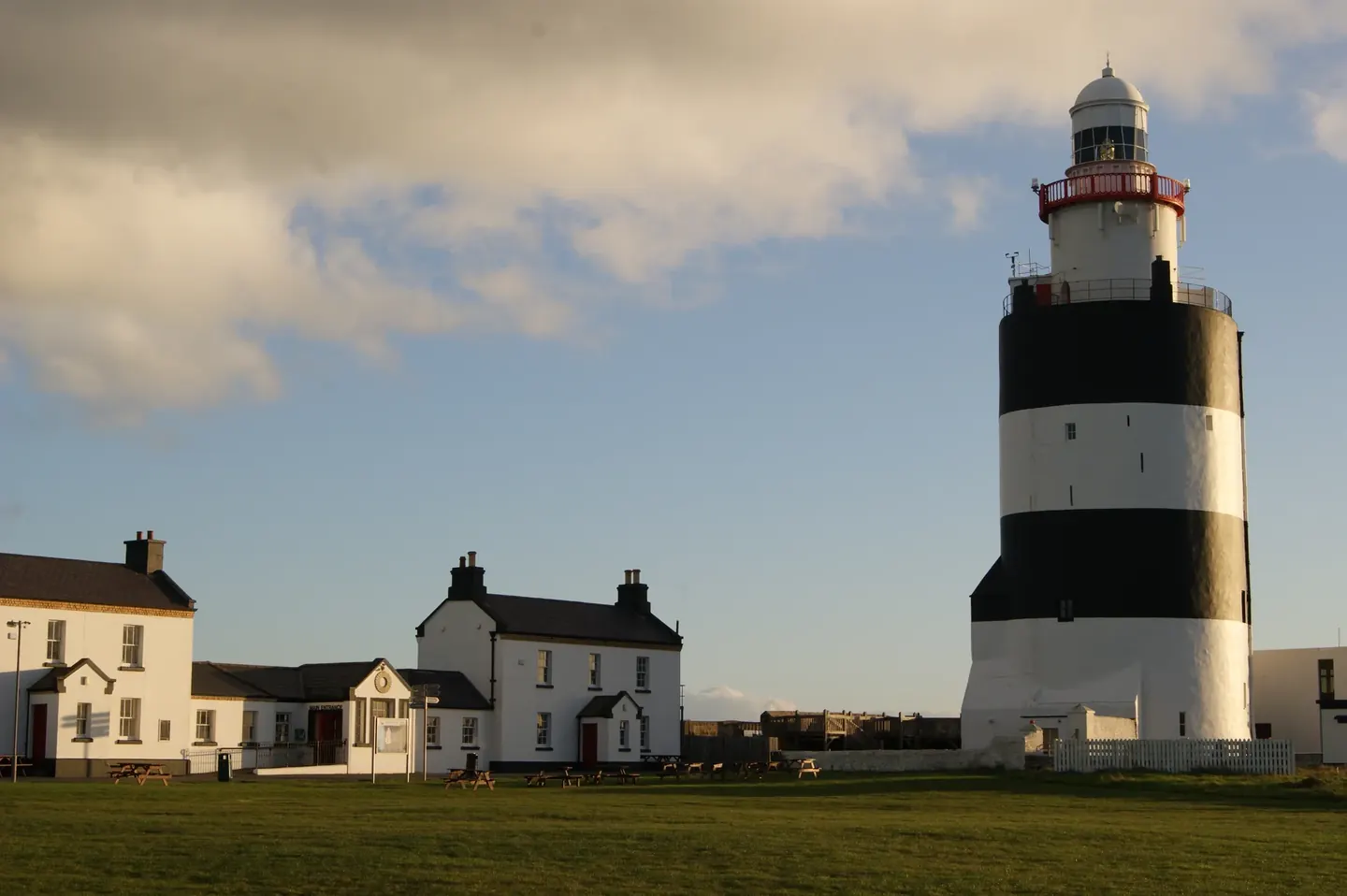
Hook Head Lighthouse stands at the mouth of Waterford Harbour, but its history is not a single clean date carved into a foundation stone. Irish Lights preserves a tradition that a fifth-century monk, Dubhán, established a beacon on Hook Point. The same authority's current history says William Marshal ordered a lighthouse there around 1207. Its station history also records an older scholarly disagreement: some authorities attributed the first stone tower to Raymond LeGros around 1172, while more recent authorities cited there attribute it to Marshal in 1245. Those dates should remain in view together.
A beacon in a maritime landscape
Irish Lights places the monastery associated with Dubhán about 1.6 kilometres north of Hook Point, at Churchtown, overlooking the entrance to Waterford Harbour. The authority says that, according to tradition, the monk established a beacon on the point. Its historical account describes it as likely a fire burning timber or other local fuel on a mound or pile of stones. The account presents this as a tradition, not a surviving fifth-century operating log. The landscape and the name preserve a connection, but the exact form of the earliest signal is not directly documented in the same way as a later tower.
Why the medieval dates differ
The station history offers two attributions for the first stone tower. It notes that some authorities associated it with Raymond LeGros and a date around 1172; it then says more recent authorities attribute the tower to William Marshal in 1245. Irish Lights' broader institutional history instead says Marshal ordered the building around 1207, to guide boats upriver to New Ross, and enrolled monks as the first keepers. These statements do not line up into one precise year. They may reflect a distinction between a proposed early structure, an order to build, and the tower that later sources identify, but the sources do not resolve every detail in the same way.
A tower altered from within and without
Irish Lights describes the original tower as about 18 metres high and 8.5 metres in diameter. It was later enlarged to about 24 metres high and 12 metres in diameter, with a spiral stone stair formed between the outer face of the old wall and the inner face of the newer one. The authority says the date of that enlargement has not been established and explicitly cautions that it was not carried out during Richard Reading's tenure. Such construction details are unusually revealing: the tower is not simply an old shell that received a modern lantern; parts of its fabric record an expansion whose exact chronology remains open.
From open fire to engineered optics
Irish Lights records a new lantern and fixed dioptric lens in 1864, followed by coal gas in 1871. A revolving third-order optic replaced the dioptric lens in 1911, and electricity took over from vaporized paraffin in 1972. The sequence matters because the tower's function was repeatedly updated through different technologies rather than inherited unchanged. The light's historical range reported for 1972 is not the same as the present listing, and there is no need to force those values together. Apparatus, operating conditions and published specifications can change over time.
Keepers, custodians and a changing organization
Irish Lights' account traces the station through monastic custody, private leases, state administration, staffed operation and remote monitoring. It says that families of keepers were withdrawn in 1977, that the station became unwatched in 1996, and that equipment is now controlled and monitored through a telemetry link. The current page also calls Hook Head a fully operational lighthouse cared for by an attendant and describes the heritage centre and visitor tours. These phrases describe distinct roles: the operational aid can be monitored remotely while a person may attend to the site for other responsibilities.
A timeline that can retain disagreement
Use separate entries for a traditional beacon, an attributed building campaign, an enlargement and an equipment change. If two official summaries assign different medieval dates, record each attribution with its source instead of averaging them into a new date. An order to build and a surviving phase of masonry may be related without being the same event.
The enlargement described in the station history is particularly useful because it preserves an unknown. A larger wall and stair arrangement are documented, while the exact date remains unsettled. Leaving that date open is more accurate than placing the work beside the nearest named administrator simply to complete the timeline.
Compare this with the later equipment sequence, where lamps, lens and fuel changes have more specific dates. The uneven precision is a feature of the surviving evidence. An account does not need every century to supply the same number of facts in order to explain why the tower continued to matter.
For visitors, the result is a better question than asking for the one true age of the whole lighthouse: which part of the building or service does this date describe? The answer can include medieval fabric, later alterations and current equipment without forcing them into an unchanged monument.